Welcome to One Thing Better. Each week, the editor in chief of Entrepreneur magazine (that’s me) shares one way to achieve a breakthrough at work — and build a career or company you love.
Please forward this newsletter to someone you appreciate! And if you received the forward, please subscribe here.
A few months ago, I spoke to a roomful of HR professionals.
One of them raised her hand with a question.
“Do you think AI is going to replace us?” she asked. “I see AI startups offering HR services, and it’s freaking me out.”
Other people nodded. They’re worried too. And of course, people everywhere are asking a version of that same question: How will AI impact me?
Here’s my answer: Think of AI like a microwave oven.
It sounds silly, I know. But it gives you a way to look at every scary AI headline and ask a simple question: Is this a permanent change, or is it just someone trying something?
Most of the time, it’s the latter. Once you see that, the fear starts to fade… and something better takes its place.
The microwave analogy
Here’s how AI is like a microwave oven:
The microwave is incredible, revolutionary, mind-blowing technology. It’s in all our homes. It can save us a lot of time.
But very importantly, we don’t cook every meal in the microwave.
Why not? Because we spent decades experimenting with the microwave, and we learned what it’s good at cooking… and what it’s very bad at cooking.
This wasn’t obvious at first! When the microwave entered homes in the 1960s, people stuck literally everything in there. Steak. Live lobsters. Just look at this old ad! Is that a whole turkey!?
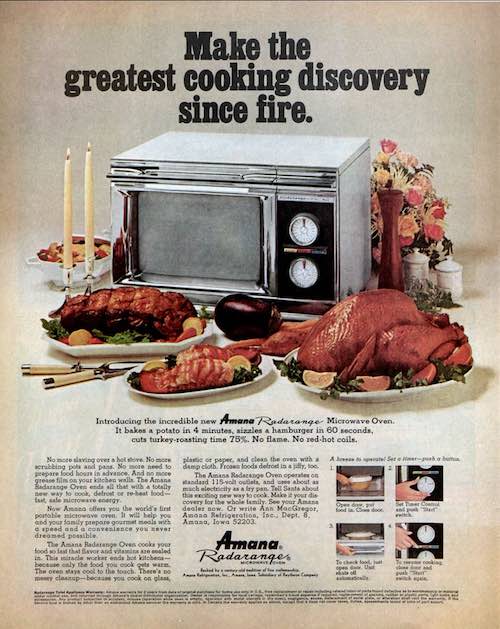
But after experimenting with it for years, we learned some very important things:
We discovered that microwaves are excellent at reheating pizza, but terrible at steak, lobster, Thanksgiving dinner, and many other things. Then we adjusted accordingly.
This is a necessary process. It’s how we fit new technologies into our lives. And it’s what we’re doing with AI now.
We simply do not know what AI is good for, or what it’s not good for. The moment of experimentation and discovery is happening right now, every day.
Which means…
We are sticking everything into AI
Every task. Every job. Every idea. It’s all going into the AI microwave.
This makes people anxious, and understandably so. Experimentation can be messy and ugly, and it can cause real harm. I’m not trying to minimize that.
But let’s not confuse trial for success. We often see someone try something with AI, and then assume the trial will lead to massive, irreversible change. And that’s just not true.
Just because someone tries something, that doesn’t mean it’ll work.
I can imagine the counterargument here: But AI keeps getting better. The microwave didn’t. That’s true. But the question isn’t just about what the technology can do. It’s about what people want it to do.
Here’s a good example of what I mean.
What Redfin got wrong
Let’s set AI aside for a moment and rewind the clock a little… to 2005.
That’s when Glenn Kelman became CEO of a real estate startup called Redfin. Its goal was to make houses easier to buy and sell. And Kelman got to wondering: Could software replace the real estate agent?
Technically, this was possible. People absolutely could buy a house through a website, with no human involved.
But when Redfin offered that option, most people didn’t want it.
Instead, they wanted someone to give them a personal tour of houses. And they had other questions. And they wanted to talk to a human.
So Redfin changed its approach. Instead of trying to replace real estate agents, it started hiring real estate agents. “Then the business started growing much, much faster,” Kelman told me.
So, will AI replace HR?
Now let’s go back to the woman who asked me that HR question.
Will AI replace HR? My guess is no, at least not entirely. Some parts might work, and some parts won’t. Nothing you see today is final.
Just look at what’s happening in the world: Companies are laying off workers, then re-hiring them. People are using AI to replace copywriters, then hiring copywriters to fix all of AI’s mistakes. Not every experiment works.
But experiments can also be fascinating, and we can still learn a lot. And you don’t have to watch from the sidelines. You can and should run your own experiments: Try AI (or anything new!) in parts of your work. See what succeeds and what doesn’t. Come up with ideas to test. And when someone else tries something, remember that success is not a foregone conclusion.
Today, it seems absurd that people once microwaved lobsters. In a few decades, people will look back at us the same way. They’ll laugh at the dumb things we tried with AI, and they’ll also appreciate what we learned from those experiments.
So the next time an AI headline scares you, ask yourself: Is this the future, or is this just a lobster in a microwave? Usually, it’s the lobster.
Now you can figure out what belongs there instead.
That’s how to do one thing better.
Happy Thanksgiving, and I’ll see you next week!
Reach my 85,000 readers… for just $25
I teased this a few months ago. Now it’s finally happening…
Want to reach my newsletter audience, but at a fraction of the cost?
I’m launching Community Ads — it’s like classified ads, but designed for you, the community of readers.
So many of you are entrepreneurs, small business owners, and side hustlers. I want you to share and grow together!
Here’s how it works:
- Pay $25
- Provide a 5-word headline, plus 25 words and one hyperlink.
- Advertise whatever you want!
I’ll publish it at the next available opportunity, typically between 1-3 weeks.