Welcome to One Thing Better. Each week, the editor in chief of Entrepreneur magazine (that’s me) shares one way to achieve a breakthrough at work — and build a career or company you love.
Today’s edition is sponsored by Riverside, the leading platform for podcasting simpler and faster. Learn more below.
You need help from someone. Maybe it’s a favor, an introduction, or just a little support.
But you don’t ask.
Why? Because it’s uncomfortable! And you don’t want to bother people! So you figure it out alone, or don’t do the thing at all.
I used to think this way. Then I discovered something shocking: By not asking for help, I was hurting myself… and my closest relationships!
Today, I’ll help you become better at seeking help — so you can live a richer life, and build better relationships
Then I’ll show how this advice transformed the company GoFundMe, to the tune of $250 million.
When I had to ask everyone
I love doing favors for friends. And I hate asking for favors in return.
But when my book came out in 2022, I had no choice. I needed to ask everyone I knew for something — to buy it, post about it, have me on their podcast, whatever. I was nervous the whole time.
Then many of my friends said the same thing:
“Thank you for asking,” they’d reply. “You’ve done so many favors for me, and you never gave me the chance to return it, which I’ve felt awkward about. So I’m happy to finally help you!”
This shocked me, and forced a realization: I’d always assumed asking for help was the burden. But the real burden was not asking for help!
People want to help. Relationships are reciprocal. This realization changed how I related to my friends, creating a free-flowing give and take. I’m so much closer with people as a result.
And when GoFundMe made a similar realization, it was worth millions.
The mystery at GoFundMe
You surely know GoFundMe: It’s the largest fundraising platform, where anyone can create a campaign to raise money.
Their CEO, Tim Cadogan, recently told me about a problem at the company: About 25% of users would create a campaign, and then never share it with anyone. Which meant it never got funded.
The GoFundMe team was flummoxed. What was the problem?
They started interviewing users who never shared, and found a few explanations.
- Some people assumed GoFundMe would drive donations itself.
- Some didn’t know what to say when they shared.
- But the biggest problem of all was: “Asking for help is really hard,” Tim says. “I have never met a customer who said doing this was easy.”
This was a revelation at GoFundMe. They’d built a great tool for raising money — but to make it work, they needed to help people get past the discomfort of actually using it.
What GoFundMe did about it
GoFundMe started treating the emotional barrier as a product problem. They built an AI coach that walks people through creating their fundraiser, then nudges them with small, specific daily actions — like, “Text ten people you trust today, just to let them know what’s happening.”
And Tim gave me the single most useful piece of advice to come out of it:
The most effective way to ask for help is direct, one-on-one, with a personal touch specific to your relationship, followed by a gentle follow-up if you don’t hear back.
“People are busy and they may not be ignoring you. They may have just missed it,” he says. “So that little nudge again is critical.”
For GoFundMe campaigns, this version of direct sharing (usually by text or WhatsApp) is roughly six times more effective than just posting something publicly.
(And it’s exactly what I did when asking favors for my book. I didn’t mass-email people. I reached out individually, talked about our relationship, asked for a specific favor, and said why it would be meaningful to me. Almost everyone said yes.)
Since adding the AI coach, GoFundMe customers share about 10% more than before — and that’s driven over a quarter of a billion dollars in additional fundraising this year alone.
That’s worth saying again: Once its users learned to ask for help, they raised an extra $250,000,000 in one year. Holy crap.
The real lesson in all this
As I talked to Tim, I realized: GoFundMe had built a product around something I learned by accident with my book.
I didn’t want to ask for help. Then I did it, and I discovered that people wanted to help me. They just didn’t know how.
The help is already there, just waiting for you to ask.
And asking for it is not selfish.
If you’re building real relationships, grounded in trust, then asking is actually generous. It’s what lets a relationship become reciprocal instead of one-sided.
So, yes, give people the gift of your care. Help them. Do favors for them. Do it gladly.
But give people the gift of your need, too. They want it.
All you need to do is ask.
That’s how to do one thing better.
Make Content Faster and Easier!
People often think that “more gear” means “more professional”…
But actually, less complication means more room for creativity. Especially in video and podcasting.
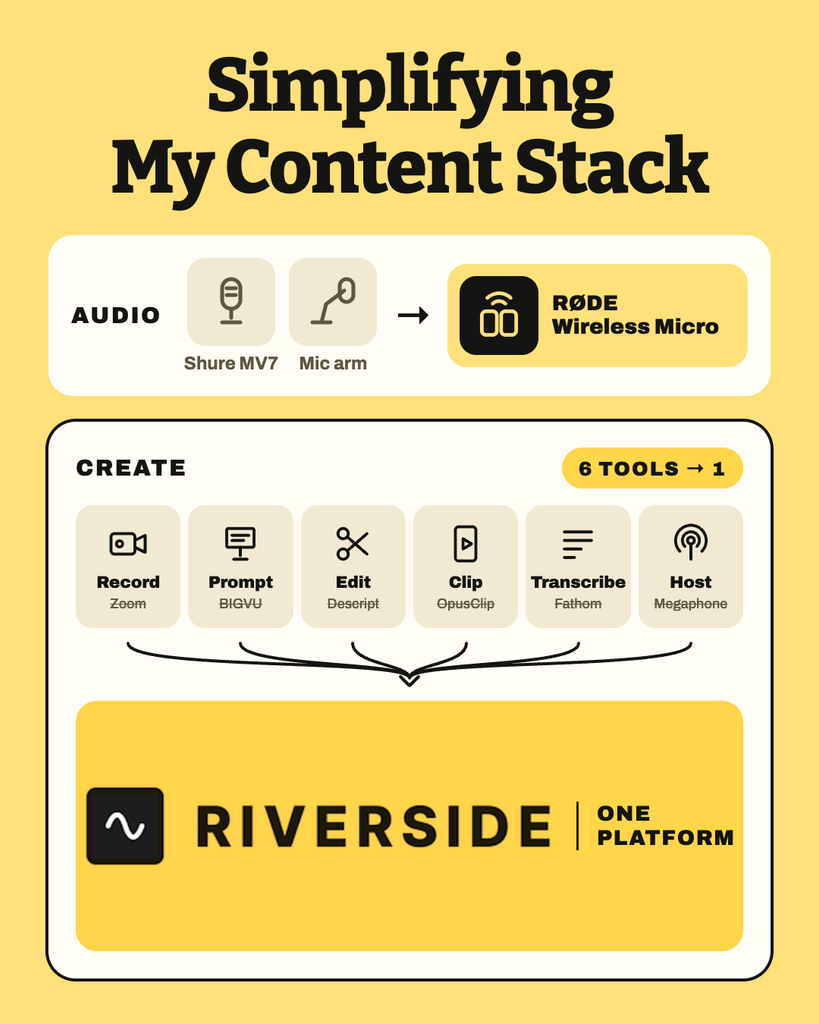
As you can see above, I replaced 8 tools this year… and Riverside helped replace 6 of them all by itself!
Riverside does six jobs now: Recording, teleprompting, transcribing, editing, clipping, and hosting.
- I record with a teleprompter and save 4K files locally with separate tracks, so guests look and sound like they’re in the room.
- I edit by editing the transcript. Delete a sentence, and the video cuts itself.
- Riverside’s AI “Magic Clips” feature automatically creates, schedules, and posts on social.
- Then Riverside also hosts the podcast and pushes it to Apple, Spotify, everywhere.
It’s more power for less cost. A creator’s dream!
If you want to make content creation simpler and faster, check out Riverside.